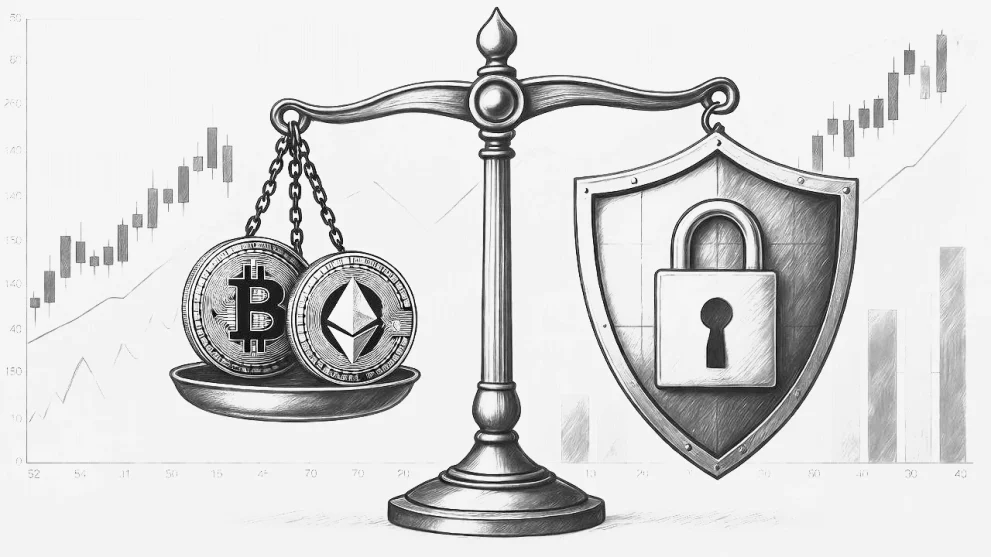
Hey crypto folks! If there’s one lesson that’s kept me profitable through crypto’s wild rides since 2014, turning initial scraps into a multimillion-dollar portfolio, it’s mastering risk management. In the world of digital assets, risk management isn’t just a safety net—it is the engine of consistent profitability. Without it, even the most sophisticated technical analysis won’t save you from being wiped out by a sudden crypto bear market crash or a systemic liquidity event.
Risk management isn’t “sexy.” It’s not about chasing the next 100x meme coin moonshot or blindly “apeing” into a high-yield DeFi protocol. It is, however, the backbone of every professional trader I’ve mentored. In my book Risk it All, Earn it All, I dive deep into the mindset required to survive these cycles. It’s what allows me to maintain a real estate empire and fund a luxury lifestyle while the market is in “Extreme Fear.” In this expanded guide, we will break down proven techniques to protect your capital, calculate position sizing for crypto, and leverage advanced tools to secure gains in the volatile landscape of late 2025.
As we sit in December 2025, the market structure has shifted. After Bitcoin hit an all-time high of approximately $123,000 in October, we’ve seen a healthy but sharp 30% correction toward the $88,000–$92,000 support levels. This transition into an “Institutional Era” means that while volatility is still present, the drivers have changed. Spot Bitcoin ETFs, Fed rate decisions, and global liquidity cycles now dictate the rhythm of your portfolio’s value.
Section 1: Understanding Crypto Volatility and Market Cycles
Volatility is the hallmark of the cryptocurrency market—a double-edged sword that creates immense wealth for the disciplined and “reks” the impulsive. Unlike traditional equities, where a 5% daily move is a major event, crypto assets frequently swing 10–20% within a single 24-hour candle. This extreme price fluctuation is driven by a combination of high leverage, speculative retail sentiment, and increasingly, institutional rebalancing.
To succeed, you must first distinguish between Historical Volatility (what has already happened) and Implied Volatility (what the options market expects to happen). In the current Q4 2025 climate, implied volatility has spiked as traders hedge against year-end FOMC decisions. By tracking the 25-delta skew on platforms like Deribit, you can see if the “big money” is buying downside protection (puts) or betting on a recovery (calls).
Historical data serves as a stark reminder of the “ruin risk” inherent in this asset class. During the 2017–2018 cycle, Bitcoin plummeted 84% from its peak. In 2022, the total market cap crashed from $3 trillion to under $800 billion. However, those who understood market cycle theory used those drawdowns to accumulate. If you want to avoid being exit liquidity for whales, you need to understand how to spot crypto pumps before they explode, ensuring you enter based on data rather than hype.
Section 2: Position Sizing—The Secret to Survival
If you take only one thing from this guide, let it be this: Position sizing is more important than your entry price. Proper sizing ensures that no single “black swan” event can end your trading career. The golden rule of professional trading is to never risk more than 1–2% of your total account equity on a single trade.
The Math of the 1% Rule
Many beginners confuse “position size” with “risk.” If you have a $100,000 account and you buy $10,000 worth of Solana (SOL), your position size is 10%. However, your risk is determined by where you set your stop-loss order. If you plan to exit the trade if SOL drops 10%, you are risking $1,000 (10% of $10,000), which is exactly 1% of your total $100k account. This is a sustainable strategy.
Contrast this with “revenge trading,” where a user might risk 20% to “win back” a loss. As I explain in Pump. Dump. Profit., this is exactly how retail traders get caught in the “dump” phase of a cycle. By sticking to the 1% rule, you can survive a 10-trade losing streak and still have 90% of your capital left to fight another day.
Advanced Sizing: The Kelly Criterion
For more experienced traders, the Kelly Criterion offers a mathematical way to determine optimal size based on your win rate and risk/reward ratio (RRR). If your strategy has a 60% win rate and a 2:1 RRR, the formula suggests a specific fraction of your bankroll. However, in crypto, I always recommend a “Half-Kelly” approach to account for slippage and unexpected flash crashes.
Section 3: Stop-Loss Orders and Automated Safety Nets
In a 24/7 market, you cannot be at your desk every second. Stop-loss orders are your automated defense against a “liquidating” event. In 2025, we’ve seen numerous “long squeezes” where prices drop 5% in minutes to hunt for liquidity pockets before rebounding.
Trailing Stops and OCO Orders
A static stop-loss is good, but a trailing stop-loss is better for capturing bull runs. As the price moves in your favor, the stop-loss “trails” a set percentage behind the current price. This allows you to secure gains while still giving the asset “room to breathe.”
For high-frequency trading, I utilize One-Cancels-the-Other (OCO) orders. This allows me to set a “Take Profit” target and a “Stop-Loss” simultaneously. This is essential for managing emotional trading pitfalls—it removes the need for “mental stops,” which most traders lack the discipline to honor. Learning to navigate these moves is the difference between losing it all and shifting from crypto pump and dump safety to profits.
Section 4: Portfolio Diversification and Asset Allocation in 2025
The “All-In” mentality is the quickest path to poverty in crypto. Portfolio diversification is about smoothing your equity curve. As of late 2025, the market has matured into distinct sectors, each with its own risk profile.
The “Empire Builder” Allocation Strategy
My personal portfolio allocation for the current market cycle is designed for maximum resilience:
- 50% Blue-Chip Assets: Bitcoin (BTC) and Ethereum (ETH). These offer lower volatility and higher liquidity.
- 20% Real World Assets (RWA) & Infrastructure: Tokens representing tokenized assets or DePIN. These have a lower correlation with meme coin hype.
- 15% High-Growth DeFi & Alts: Layer 1s like Solana or protocols like Aave. These provide the “alpha” during bull runs.
- 15% Cash/Stablecoins: Keeping a “dry powder” reserve in USDC is crucial. In the recent December correction to $88k, this 15% allowed me to buy the dip while others were getting liquidated.
Section 5: Managing Leverage, Margin, and Liquidation Risk
Leverage is a tool for professionals, but a weapon of self-destruction for the uninformed. Using 10x or 20x leverage in crypto is essentially gambling. With Bitcoin’s 2025 daily volatility at 4%, a 10x position is constantly on the verge of liquidation.
In mid-2025, the Systemic Leverage Ratio hit dangerous levels, leading to a massive wash-out. Today, that ratio has stabilized around 4-5%, indicating a much healthier market. If you must use leverage, I recommend staying below 3x. This gives your position a “buffer” of 33% before liquidation—enough to survive almost any standard market correction.
Section 6: Trading Psychology and Emotional Control
Your greatest enemy isn’t a whale; it is your own brain. The “Monkey Mind” is hardwired for FOMO (Fear of Missing Out). When Bitcoin was at $123k in October, the Fear & Greed Index was at 92 (Extreme Greed). That was the time to scale out. Today, with the index at 21 (Extreme Fear), the “herd” is panic-selling.
The Importance of a Trading Journal
To master emotional discipline, you must keep a trading journal. Document every entry and exit. Were you “revenge trading” after a loss? Over time, your journal will reveal patterns that no chart ever could. Use tools like CoinTracking or Delta to automate the data, but write the narrative yourself.
Section 7: Security Risks and Custody Solutions
Risk management isn’t just about market moves; it’s about counterparty risk. 2025 has seen over $2 billion in DeFi exploits. “Not your keys, not your crypto” is as true in 2025 as it was in 2014.
For long-term wealth protection, I utilize a multi-tiered cold storage strategy:
- Hardware Wallets: Ledger Stax and Trezor Safe 5 are the current industry standards.
- Multisig Wallets: For large BTC stacks, I use Gnosis Safe (Safe). This requires 2-of-3 signatures to move funds.
- Security Hygiene: I use dedicated laptops for trading and enable 2FA via hardware keys (Yubikey), never SMS.
Section 8: Tax and Regulatory Risks: The 2025 Landscape
As crypto goes mainstream, regulatory risk has intensified. In the US, the 2025 long-term capital gains tax rates remain a major factor. Meanwhile, Europe’s MiCA directives have brought unprecedented transparency. Ignoring crypto taxes is a risk that can lead to massive fines. I use Koinly to ensure every swap is accounted for. Staying compliant is simply the cost of doing business.
Conclusion: Building a Risk-Aware Mindset for 2026 and Beyond
The transition from a “broke trader” to a “crypto millionaire” isn’t about finding the perfect indicator. It is about mastering the math of survival. As we look toward 2026, the market will continue to evolve. If you respect position sizing, honor your stop-losses, and maintain emotional discipline, you will not just survive—you will thrive.
Master risk, and you turn the wildest market in history into your personal wealth machine. I’ve built an empire using these exact principles. You have the tools; now you need the discipline to use them.
What is your primary risk management rule for this correction? Drop a comment below and let’s secure those gains together!
Finally, someone emphasizing volatility measurement instead of just fearing it. ATR and position sizing are the real alpha in this market.
Been through the 2018 and 2022 crashes — this guide nails what most influencers skip: managing risk beats chasing the next 100x coin every time.
Calculate position size guys! Too many retail traders skip the math and treat leverage like a casino bet.